Diffusion-map embedding is a versatile method for nonlinear dimensionality reduction. One variant of this method has transformed analyses in much of imaging neuroscience by robustly detecting co-activity (functional) gradients, low-dimensional representations of correlation networks that capture important properties of functional organization.
Here, we show an approximate equivalence between the components of co-neighbor networks — a simple class of integer networks — and this variant of diffusion-map embedding in our example brain-imaging data.
File ‘abct_utils.py’ already there; not retrieving.

Note: you may need to restart the kernel to use updated packages.
Visualize co-neighbor networks
Co-neighbor networks, as their name suggests, encode the number of shared 𝜅-nearest, or strongest correlated, neighbors between pairs of nodes. We first visualize the structure of co-neighbor correlation networks in our data.
# Define and visualize co-neighbor networks# (kappa = 0.1 is equivalent to the top 10% nearest neighbors)Cn = abct.kneighbor(C, "common", 0.1).toarray()fig_imshow(Cn[np.ix_(ordc, ordc)],"Correlation co-neighbor network","viridis").show()
Get co-activity gradients
Next, we compute the components of co-neighbor networks.
np.random.seed(1)# Define co-activity gradient parameters (see kneighbor)k =5kwargs = {"type":"common", "kappa":0.1, "similarity":"network"}# Weighted co-activity gradientsV_wei = abct.kneicomp(C, k, "weighted", **kwargs)V_wei = V_wei[:, [0, 1, 3]] # match components to standard order# Binary co-activity gradientsV_bin = abct.kneicomp(C, k, "binary", **kwargs)V_bin = V_bin[:, [1, 2, 3]] # match components to standard order# Flip sign of weighted gradients to match binary gradientsV_wei *= np.sign(np.sum(V_wei * V_bin, 0))
Show maps of weighted and binary co-activity components
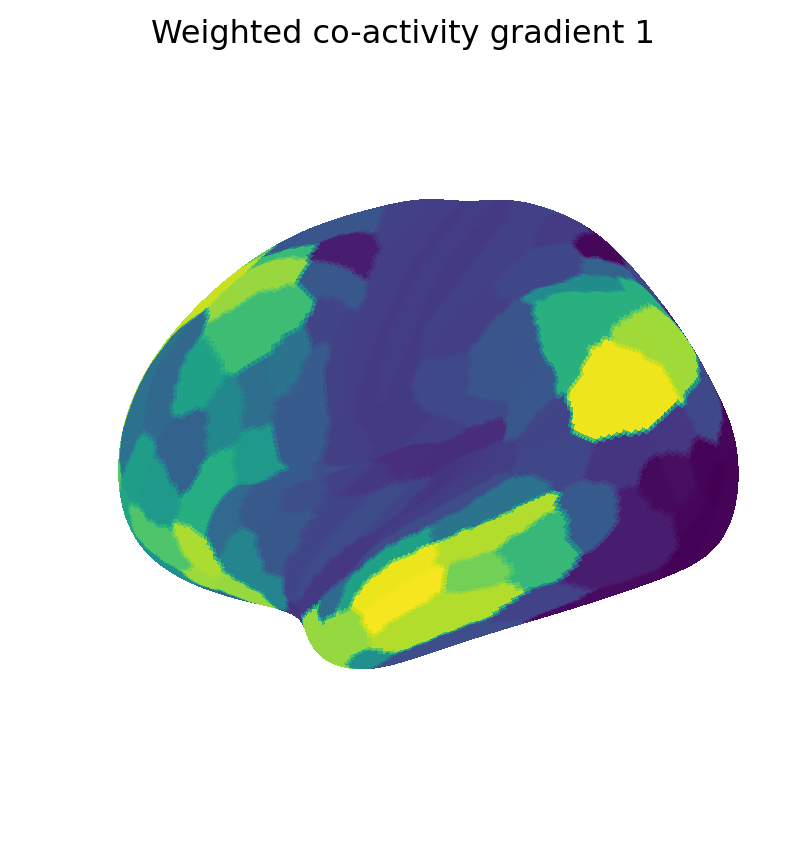
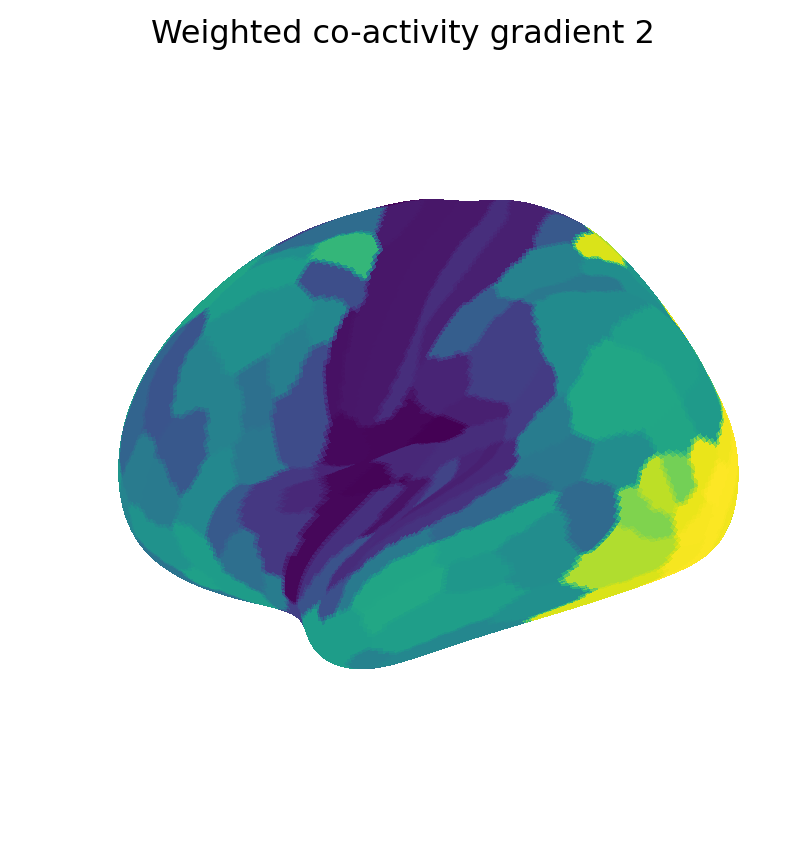
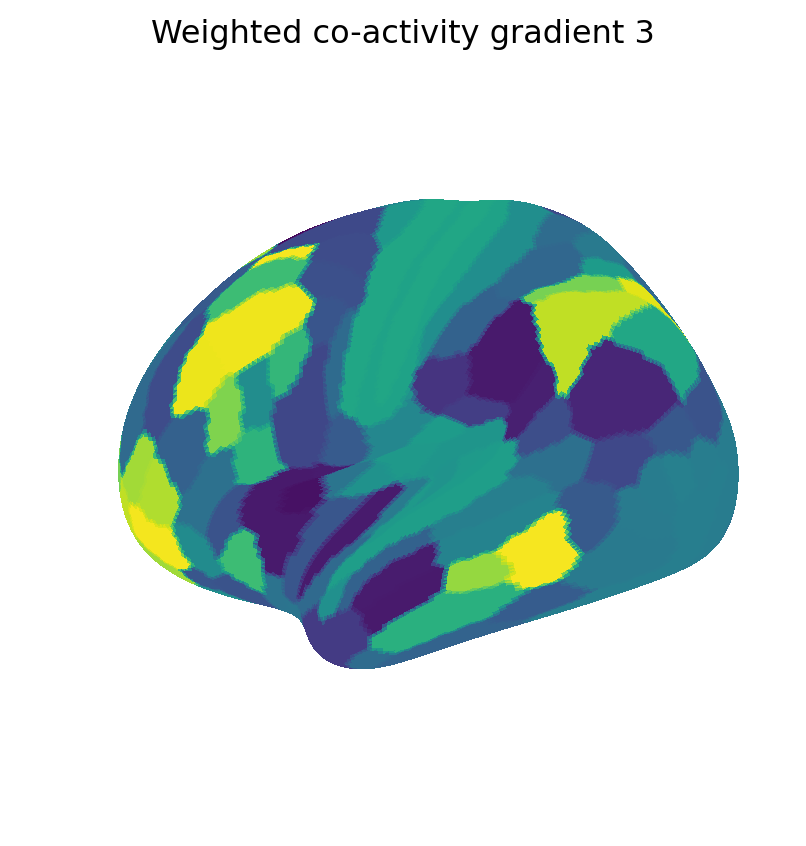
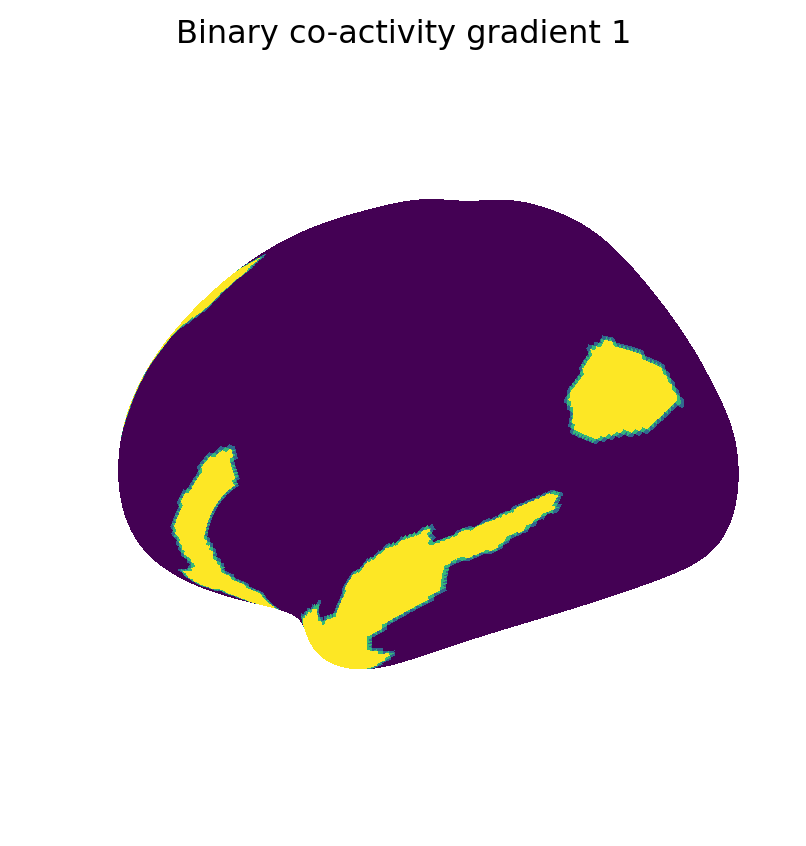
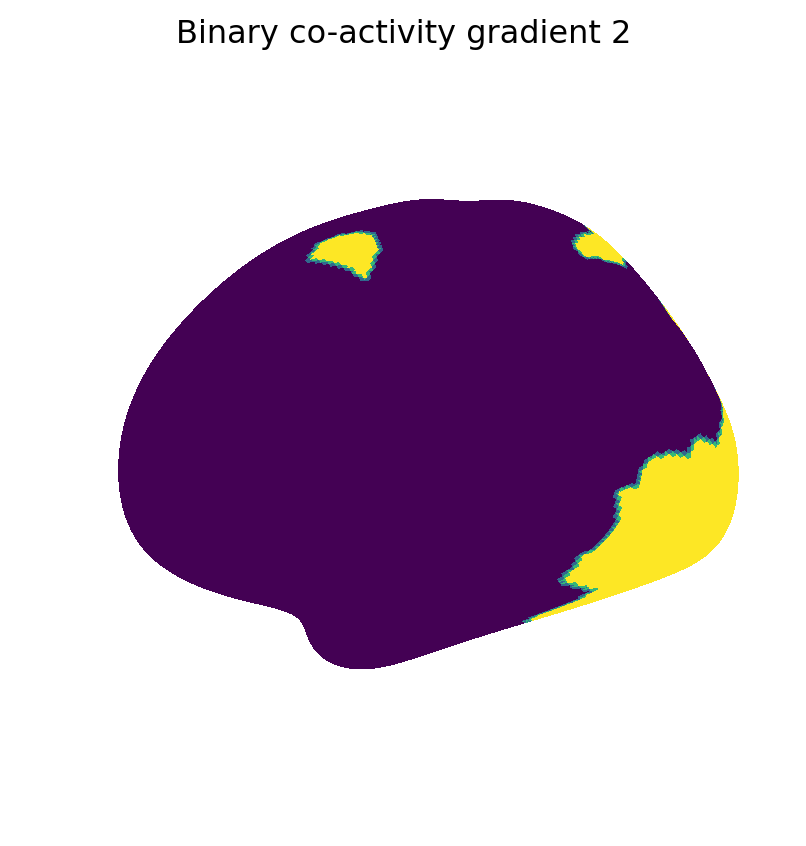
We now show the maps of three weighted and binary co-activity components. These maps closely resemble the maps of co-activity gradients estimated with diffusion-map embedding.
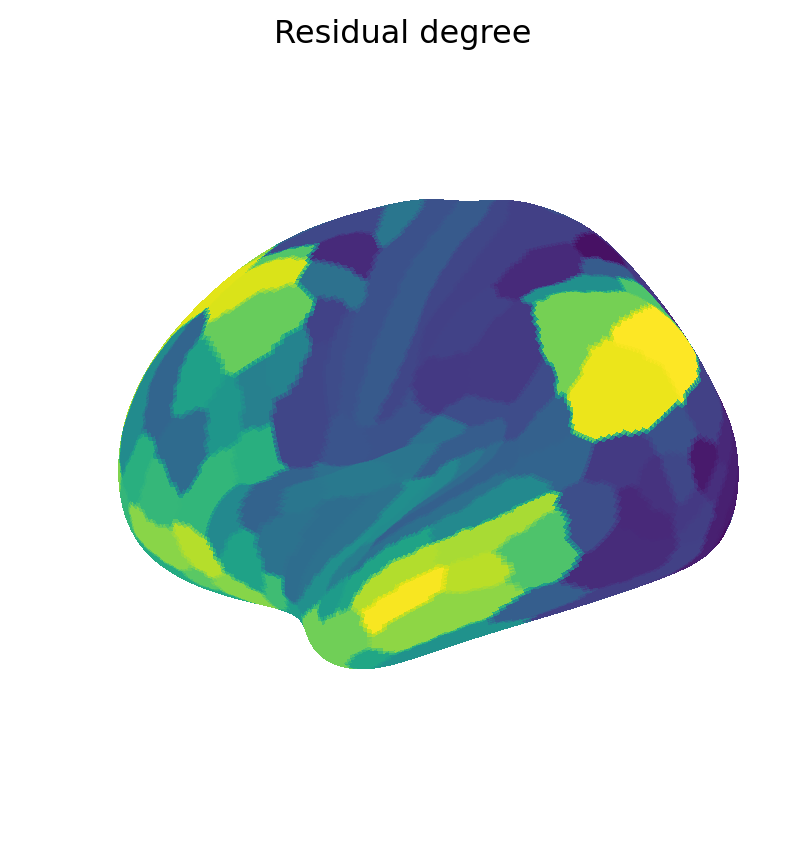
The primary co-activity gradient plays an especially important role in imaging neuroscience because it represents a transition between primary and association cortical areas. We conclude by showing a particular simple approximation of this component, as the degree of the residual network after first-component removal, or global signal regression.