The squared coefficient of variation is a basic measure of normalized dispersion. It is defined as the ratio of the variance over the squared mean, or equivalently, the ratio of the first and second degrees.
Here, we show that in networks with relatively homogeneous connections within modules, the squared coefficient of variation is equivalent to a variant of the participation coefficient, a popular module-based measure of connectional diversity. It is specifically equivalent to the k-participation coefficient, the participation coefficient normalized by module size. We show these equivalences in structural and correlation co-neighbor networks from our example brain-imaging data, because these networks have high connectional homogeneity by construction.
Compute squared coefficient of variation and k-participation coefficient
We now compute the squared coefficient of variation and the k-participation coefficient for these co-neighbor networks. Note that the k-participation coefficient is defined for a specific module partition, and we therefore compute it for a range of partitions.
# Get squared coefficient of variationWV = abct.dispersion(Wn, "coefvar2")CV = abct.dispersion(Cn, "coefvar2")# Get participation coefficientsK = np.arange(5, 30, 5) # number of clustersrepl =10# number of replicates# Set random seednp.random.seed(1)### Run Loyvain k-modularityWP = [None] *len(K)CP = [None] *len(K)for i, k inenumerate(K):print(f"Number of clusters: {k}") Mw = abct.loyvain(Wn, k, "kmodularity", replicates=repl)[0] Mc = abct.loyvain(Cn, k, "kmodularity", replicates=repl)[0] WP[i] = abct.dispersion(Wn, "kpartcoef", Mw) CP[i] = abct.dispersion(Cn, "kpartcoef", Mc)
Number of clusters: 5
Number of clusters: 10
Number of clusters: 15
Number of clusters: 20
Number of clusters: 25
Show maps of the squared coefficient of variation
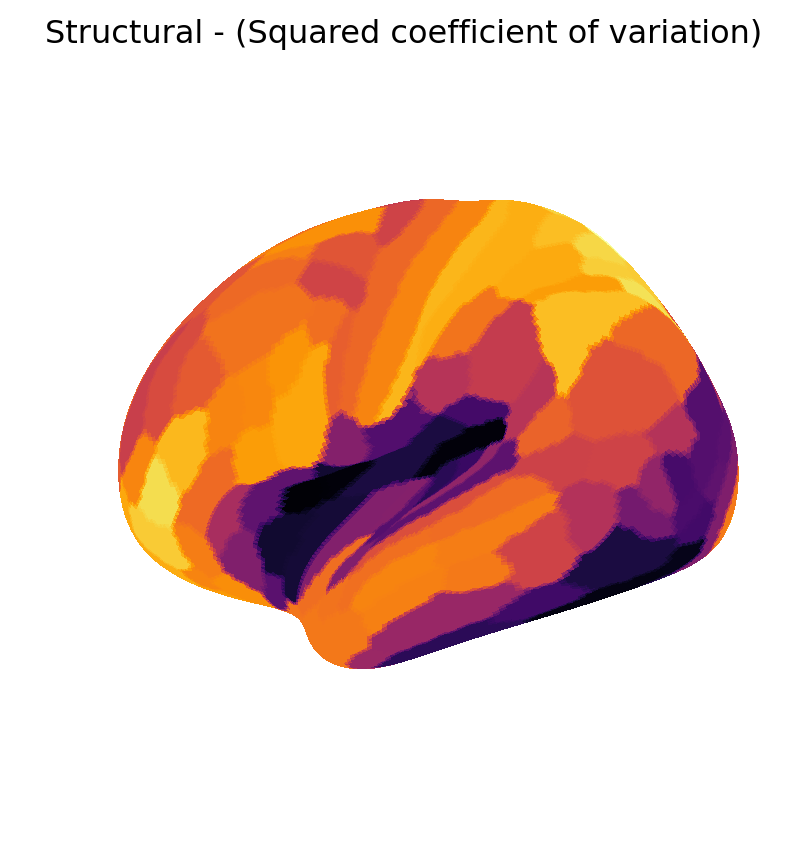
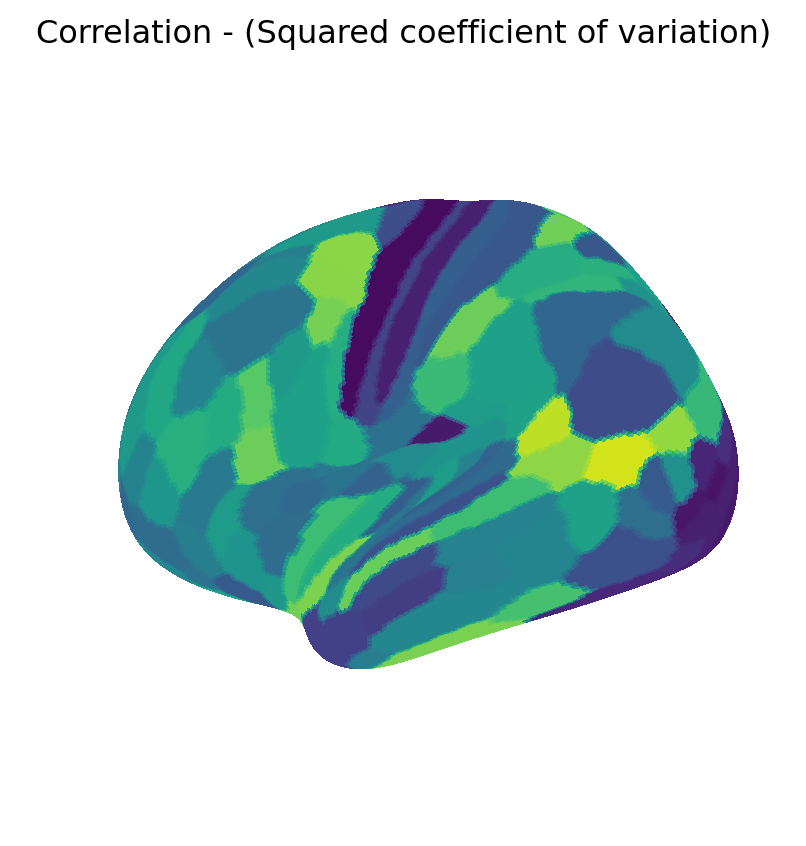
We next show the maps of the squared coefficient of variation, separately for the structural and correlation co-neighbor networks.
cv2s = {"Structural - (Squared coefficient of variation)": (- WV, "inferno"),"Correlation - (Squared coefficient of variation)": (- CV, "viridis")}for i, (name, vals_cmap) inenumerate(cv2s.items()): vals, cmap = vals_cmap fig_surf(vals, name, cmap)
Scatter plots of squared coefficient of variation and k-participation coefficient
Finally, we show the scatter plots of the squared coefficient of variation and the k-participation coefficient, separately for the structural and correlation co-neighbor networks. As expected, the squared coefficient of variation and the k-participation coefficient are strongly correlated, and this correlation increases with the number of modules, as the within-module connectivity becomes more homogeneous.
normalize =lambda x: (x - x.min()) / (x.max() - x.min())for i inrange(len(K)):if i ==0: fig = fig_scatter(- np.log10(1- WP[i]), normalize(- WV))else: fig.add_scatter(x =- np.log10(1- WP[i]), y = normalize(- WV), mode="markers")r = np.corrcoef(WV, np.array(WP))[0][1:]fig.update_layout(xaxis_title="log-rescaled k-participation coefficient", yaxis_title="rescaled - (Squared coefficient of variation)", title=f"Structural network: r ~ {-np.mean(r):.3f}", showlegend=False).show()for i inrange(len(K)):if i ==0: fig = fig_scatter(- np.log10(1- CP[i]), normalize(- CV))else: fig.add_scatter(x =- np.log10(1- CP[i]), y = normalize(- CV), mode="markers")r = np.corrcoef(CV, np.array(CP))[0][1:]fig.update_layout(xaxis_title="log-rescaled k-participation coefficient", yaxis_title="rescaled - (Squared coefficient of variation)", title=f"Correlation network: r ~ {-np.mean(r):.3f}", showlegend=False).show()